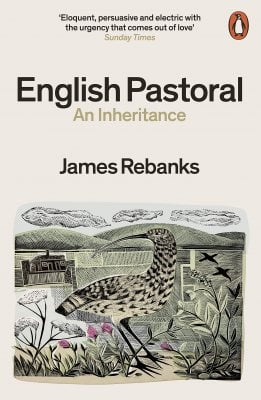
image from Waterstones website
Powerful and persuasive about the damage the industrialisation of farming has had on the environment and people’s lives, this is a wonderful book.
After a childhood immersed in the traditional farming ways of his grandfather’s farm in the Lake District, James Rebanks recounts how his father’s farm became the new norm – how the ubiquitous use of chemicals has left the countryside impoverished. Fewer birds and insects, soil almost sterile, farmers isolated and stressed and the old supportive social networks broken. And in only a couple of generations.
His descriptions of life on his grandfather’s farm are beautiful and lyrical. There are moments that really sing. When he’s helping repair an old stone wall his grandfather signals to him that he’s heard something:
He held his finger to his mouth. A hedgehog snuffled out from the long dead grass by the field edge. Oblivious to us, it trotted along like a Victorian woman raising her petticoat above her skinny legs, until it reached him, sniffed nonchalantly, then climbed over the toe of his boot, and on down the field edge until it was lost again in the grass. I was grinning from ear to ear. Grandad was beaming like a little boy, and said in a hushed pantomime voice, ‘That was Mrs Tiggy-Winkle taking her washing home.’
It’s moments like this that make the book so memorable and moving. That make us realise how much our world has changed since that idyllic time. When did you last see a hedgehog? It’s 30 years since I saw one here in West London.
In spite of the gloom, this is a wonderfully hopeful book. Following his father’s death, Rebanks has taken over the farm and is gradually reintroducing some less intensive farming methods – rewilding areas, using fewer chemicals and river conservation amongst many. But he’s not going back to the old ways completely. That wouldn’t work in the 21st century. He’s compromising, remembering his father and grandfather’s words of wisdom. but also that you have to make your own way in life.
He writes movingly about the land he loves, the small valley in Cumbria he’s known all his life and has always returned to.
I stumble across a field at a different time of day, or in different light, and I feel as if I have never seen it before – not the way it is now. The more I learn about it, the more beautiful our farm and valley becomes. It pains me to ever be away; I never want to be wrenched from this place and its constant motion. The longer I am hear, the clearer I hear the music of this valley: the Jenny wren in the undergrowth; the Scots pines creaking and groaning in the wind; the meadow grasses whispering. The distinction between me and this place blurs until I become part of it, and when they set me in the earth here, it will be a conclusion of a lifelong story of return…
This book is essential reading for anyone who cares about our world and our future. Alan Bennett describes it as ‘a heartfelt book and one that dares to hope.’
 Ali Thurm